The Warrior Shade of Maa Sita: Reclaiming the Strength Valmiki Left in Shadow
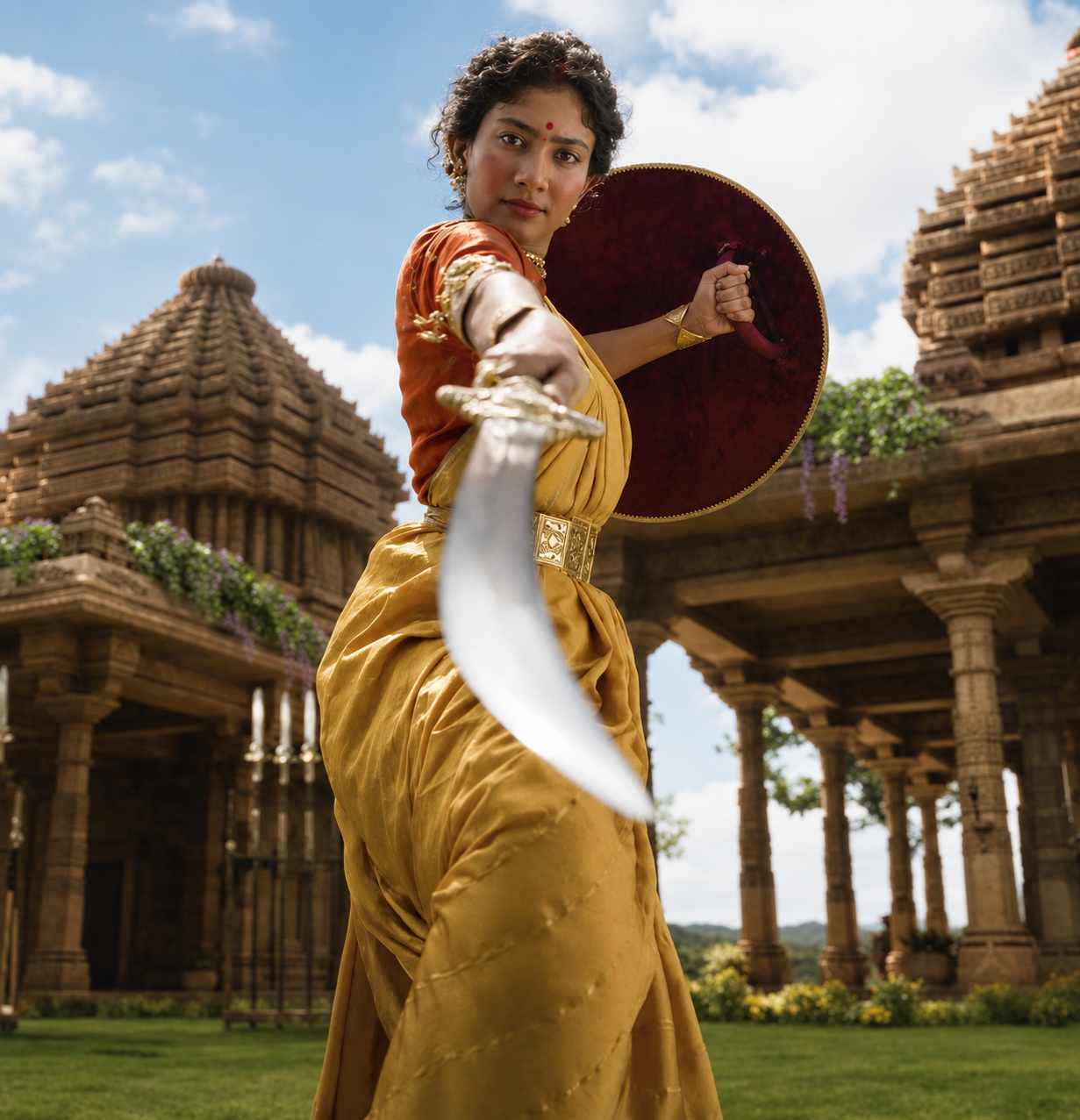
In the vast tapestry of the Ramayana, Maa Sita has long been celebrated as the embodiment of devotion, purity, endurance, and dignity. Valmiki's immortal epic paints her primarily as the ideal consort: gentle, steadfast, and self-sacrificing, whose trials illuminate dharma through suffering rather than force. Yet this portrayal, while profound, is incomplete. Buried beneath the dominant narrative lies a luminous, under-explored dimension of Maa Sita: her warrior shade. It begins not in the forests of exile or the court of Lanka, but in the sunlit courtyards of Mithila, in her childhood, when a little girl casually lifted a divine bow that defeated armies of men.
This is not a modern invention or a forced feminist retrofit. It is an ancient memory preserved in popular tradition, regional retellings, and the deeper cultural memory of the Indian subcontinent. While Valmiki chose not to dwell on it, the story endures because it reveals something essential: Maa Sita was never merely the prize of a swayamvara. She was the standard against which strength itself was measured.
In the palace of King Janaka of Mithila, there rested the Pinaka, the mighty bow of Lord Shiva. It was no ordinary weapon. Forged of celestial power, it was so heavy and so charged with divine force that even the strongest warriors of the age could not shift it from its place. Kings and princes strained against it and failed. Servants labored and collapsed. The bow stood as a silent testament to the limits of human might.
Then came the child Maa Sita.
Tradition recounts that the young princess, playing in the palace, once reached for the bow as if it were a toy. With the effortless grace of childhood and the latent power of her divine nature, she lifted it. In some tellings she moved it; in others she raised it fully. The act was not performed in challenge or display. It was almost casual: an innocent gesture that nevertheless shook the foundations of the court.
Janaka witnessed this. The king who had found the infant Maa Sita in a furrow of the earth, who had raised her as his own, suddenly understood the measure of the daughter the earth itself had given him. No ordinary prince would suffice. The man worthy of Maa Sita would have to match, or at least approach, the strength she had already demonstrated as a child. Thus was born the condition of the swayamvara: only he who could string the Pinaka would win her hand.
This is the origin of the famous bow-breaking contest. Lord Ram's feat is not diminished by this knowledge: it is deepened. When Lord Ram lifted, strung, and ultimately broke the bow, he was not merely performing a test of divine favor. He was answering a standard set by Maa Sita herself years earlier. The bow that had yielded to a little girl's hands now yielded to the prince of Ayodhya. Janaka's condition was not arbitrary pride; it was the recognition that Maa Sita's strength demanded an equal.
Valmiki's silence on this episode is significant. His Maa Sita is the embodiment of forbearance. She follows Lord Ram into exile without complaint. She endures the abduction by Ravana with dignity. She walks through fire to prove her purity. These are not the actions of a weak woman; they are the highest expressions of inner power. Yet by emphasizing her suffering and fidelity, the epic largely leaves her physical and martial potential in the shadows.
Other traditions fill the gap. In certain regional and later tellings, Maa Sita's childhood feat becomes an emblem of Shakti, the primordial feminine energy that can both nurture and destroy. The same Maa Sita who later stands unyielding before Ravana's threats, who refuses to be intimidated in the Ashoka Vatika, and who ultimately chooses the earth itself as her final refuge, is the same being who once lifted Shiva's bow. The continuity is there for those willing to see it.
This warrior shade does not contradict her devotion; it completes it. Her power is not the loud, conquering force of the battlefield but the immovable force of the earth itself: the force that can lift the unliftable and still choose restraint.
The most explicit and celebrated portrayal appears in the Adbhuta Ramayana (also known as Adbhut Ramayana), a later Sanskrit text traditionally attributed to Valmiki himself though composed centuries after the core epic. In this Shakta-oriented work, Maa Sita is revealed as Adi Shakti.
The descent of Lord Ram and Maa Sita is not primarily a personal drama between husband and wife. It is a cosmic intervention. Ravana had become a terror to the gods, sages, and all beings through the power of his austerities and boons. The purpose of the Lord Ram avatar was to destroy this evil through the ideal of the perfect man, the maryada purushottama, who fights as a kshatriya within the bounds of dharma, gathers allies, builds a bridge, and wages a just war.
True power is not merely the ability to destroy. It is also the wisdom to know when not to use that ability. Maa Sita's silence and apparent vulnerability during the abduction and captivity are themselves expressions of immense inner strength. She could have reduced Lanka to ashes. Instead she chose to remain in the Ashoka Vatika, protecting her dignity through pure will and unwavering focus on Lord Ram, while allowing the larger drama of dharma to play out.
This restraint also protects the moral architecture of the story. Had she acted in rage or personal vengeance, the narrative would have shifted from the establishment of dharma to an act of individual power. By withholding her full force, she ensures that Ravana is defeated not merely by superior might, but by the combined force of righteousness, alliance, courage, and divine will working through Lord Ram.
She does not reject the domestic or the relational. She does not need to become a man to be powerful. Her warrior nature coexists with her roles as daughter, wife, and mother. In this age where society often forces women into false binaries, either soft or strong, either nurturing or assertive, Maa Sita offers a more integrated model. She is both the child who moved the divine bow and the woman who chose exile out of love. She is both the one who set the standard for her own marriage and the one who later endured the greatest tests of character.
Maa Sita is a figure of profound contemporary power. She is not a victim waiting to be rescued. She is the original measure of worthiness. The man who would stand beside her had first to prove he could meet the strength she already possessed. Lord Ram did not merely win a contest; he answered a challenge first issued by Maa Sita's own hands. And the world that continues to revere Maa Sita would do well to remember that the earth-born princess was never only the embodiment of endurance. She was, from the beginning, a force capable of moving the immovable.
In recovering this shade of her being, we do not rewrite the Ramayana. We simply allow its heroine to stand in her full stature: gentle and fierce, devoted and powerful, the child who lifted Shiva's bow and the woman who remains, across millennia, one of the most complete expressions of strength the world has ever known.