Reflections · Lexicon Series
The World Already Has Its Defining Portrayals.Now We Have Ours.
Eleven actresses. Eleven myths.
These were not casual castings. They were cinema's attempt to give flesh and breath to figures who had lived for millennia in poetry, opera, and the collective imagination. Each actress brought something the character demanded: star power that could command a frame, talent that could hold the weight of myth, and a presence that felt larger than ordinary life.
Anne Hathaway's Penelope in Christopher Nolan's The Odyssey is no waiting figure at a loom. She is an active, dangerous, ride-or-die queen holding a kingdom together while the world tries to take it from her. Zendaya's Athena arrives with the cool, unhurried grace of a contemporary icon who has already conquered every medium she has touched. Diane Kruger's Helen in Troy was the face that launched a thousand ships because the camera believed her beauty was destiny itself.
Ursula Andress, the original Bond girl, became Aphrodite in Clash of the Titans simply by existing in that light. Rosario Dawson gave Persephone both bitterness and a lingering innocence. Honor Blackman, already a goddess of 1960s cool, played Hera as if she had always belonged on Olympus. Gal Gadot's Diana Prince carried compassion as powerfully as she carried a sword.
Maria Callas, in her only film role, became Pasolini's Medea, otherworldly, volcanic, a tragedy walking. Irene Papas, the great interpreter of Greek tragedy, made Helen feel like a force that could indeed start a war. Silvana Mangano's Penelope, and Circe, in the 1954 Ulysses was both devotion and temptation in the same luminous face. Elizabeth Taylor's Cleopatra remains the high water mark of Hollywood's ability to turn a woman into an empire.
These women were chosen because they already possessed a kind of mythic voltage. The industry understood that certain characters require more than acting.
They require a star who can stand in for an idea.
And now we have ours.
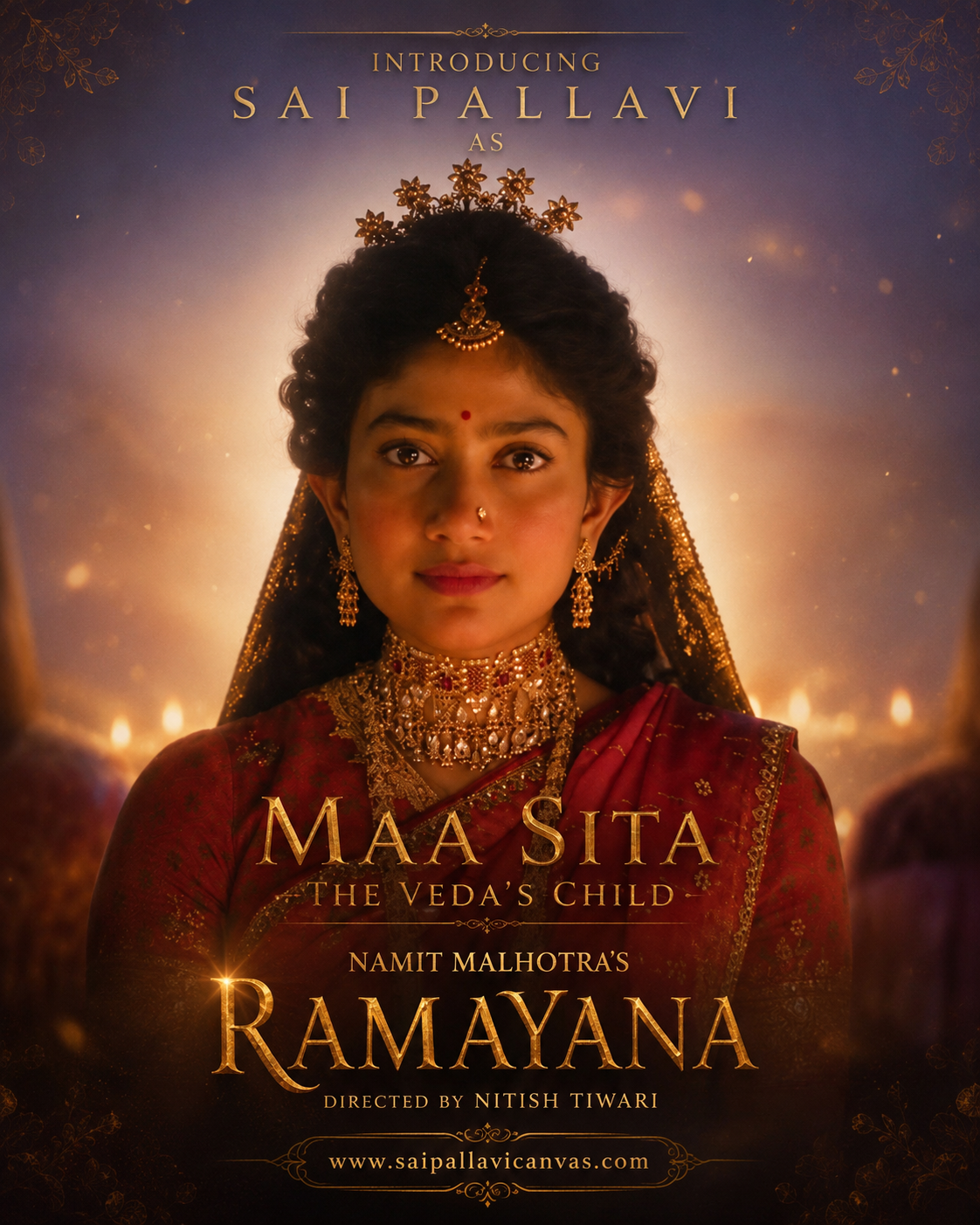
Sai Pallavi as Maa Sita.
This is not a comparison of the same scale. Maa Sita is not another mythological heroine among many. She is the biggest female portrayal our civilization has ever offered the world; our history, our culture, our Goddess. She is not a character invented for the screen. She is the embodiment of dharma, strength, devotion, and unwavering dignity. No other portrayal, however magnificent, sits on the same plane.
Sai arrived as a doctor who danced, a woman who has spent more than a decade choosing work over visibility, choosing in depth scripts, zero commercial endorsements, and a private life over the machinery of stardom. She has never needed to be the most glamorous person in the room. She has only needed to be the most truthful.
When she speaks of the character, she does not speak of ambition. She speaks of surrender. She tried to keep herself as pure as possible so that whatever reached the screen would not be performance in the ordinary sense. She offered something older and rarer: the belief that some characters are not played. They are received.
She sat in meditation and asked Sita Maa to act through her.
That is why the conversation around her Sita Maa has felt different. Some expected the conventional image, the polished, airbrushed ideal that cinema has repeated for decades. What they received instead was a woman whose beauty is inseparable from her stillness, her strength, and her refusal to perform femininity as decoration. The brief glimpse of her holding a sword and shield in the trailer was not an action beat. It was a reminder that Sita Maa was never only a wife waiting to be rescued. She was a woman of agency, endurance, and fire.
The earlier portrayals on this list were magnificent because they matched the scale of their myths with the scale of their stars. Sai Pallavi's Sita Maa is magnificent for the opposite reason.
She matches the soul of our epic history with the soul of an artist surrendering to our culture and belief.
This is the difference. The West gave us actresses who could wear the crown of legend. Bharat has given us an actress who understands that some legends do not need a crown. They need a woman who still knows how to disappear into the work, who still believes the character is larger than the performer, and who still treats it as a blessing rather than a conquest.
Some legends do not need a crown. They need a woman who still knows how to disappear into the work.
The world already has its defining portrayals.
And now we have ours.